
JournalBuilding on Your Own Terms
What If Your Business Idea Isn't Wrong, Just Incomplete?
Thinking of starting a business? Discover why failure isn't the end and how ikigai, reinvention and small experiments can help you succeed.
By Rafael Martino8 min read

Here's a statistic to make any aspiring entrepreneur nervous: according to the UK's Office for National Statistics (ONS) (opens in a new tab), only 38.4% of businesses established in 2019 were still active five years later. In 2024 alone, approximately 280,000 registered businesses ceased trading. And the reasons businesses struggle are hardly mysterious: insufficient demand, unsustainable costs, cash-flow difficulties, competition and sometimes simply getting the timing wrong. Of course, closure isn't always failure, and these numbers don't tell us what happened to every founder. Nevertheless, the warning is clear. Entrepreneurship involves risk. The statistics are real. But here's another question: so what?
Imagine if the possibility of failure had stopped people from inventing, experimenting or pursuing ideas that seemed improbable. Human progress has always involved attempts that didn't work, discoveries made by accident and people willing to question what already existed. The entrepreneurial impulse is part of that same creative curiosity. We aren't suggesting that anyone gamble their savings on a dream. Quite the opposite. We believe entrepreneurship is something you develop: through self-discovery, acquiring skills, understanding other people, making mistakes and learning to recognise which opportunities deserve your commitment. And perhaps one of the most useful places to begin isn't with a business plan at all, but with a reflection on what you're trying to build and why.
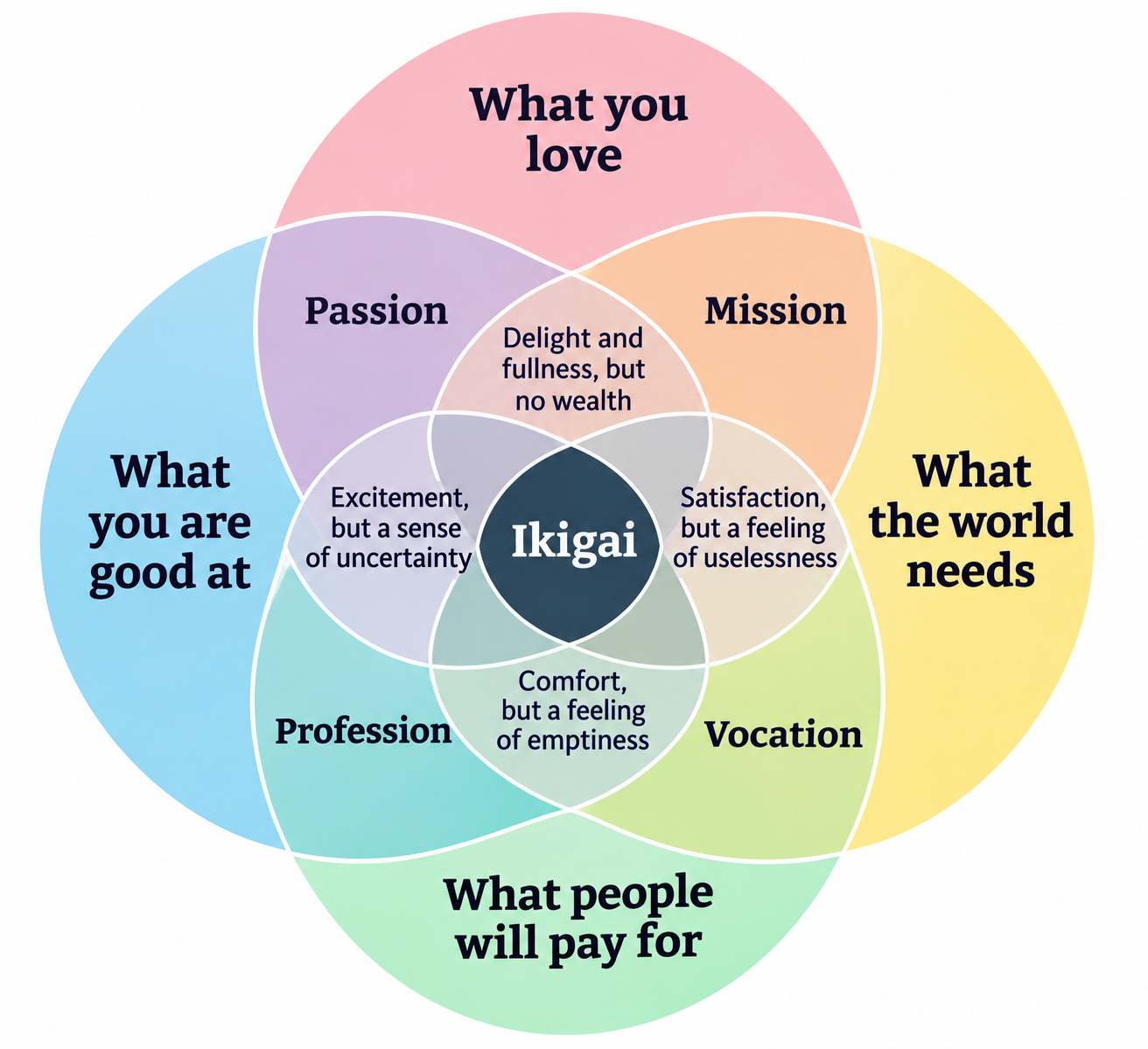
That brings us to ikigai (opens in a new tab), the Japanese concept associated with having a reason to live. Research involving more than 43,000 Japanese adults (opens in a new tab) has found an association between a sense of ikigai and lower mortality risk, although this doesn't establish that ikigai causes business success. The familiar four-circle diagram often attributed to ikigai is actually a modern adaptation of a Western purpose model, popularised by Marc Winn in 2014 (opens in a new tab). Still, we find it a fascinating tool for entrepreneurial reflection.
The framework invites us to examine four fundamental areas:
- What do you love? Your interests, motivations and the activities that genuinely engage you.
- What are you good at? Your capabilities, experience, talents and strengths.
- What does the world need? Problems worth solving and needs that remain unmet.
- What will people pay for? The value others recognise and are willing to reward financially.
Their intersections offer four additional perspectives:
- Passion: What you love and what you're good at.
- Mission: What you love and what the world needs.
- Profession: What you're good at and what people will pay for.
- Vocation: What the world needs and what people will pay for.
Eight areas to explore, with the possibility of a compelling intersection at the centre.
What if one piece is missing?
Now consider your business idea, or the business you've already started. What if its struggles aren't evidence that entrepreneurship isn't for you, but clues about where the idea needs attention?
The popular ikigai diagram describes four situations in which three areas overlap but the fourth is missing. These descriptions capture different experiences of fulfilment, uncertainty and dissatisfaction.
But what if we examined those same intersections through an entrepreneurial lens? Could they help us identify what isn't working in a business and where to look for answers?
Let's explore.
1. Delight and fullness, but no wealth
You love it. You're good at it. The world needs it. But people aren't paying for it.
Perhaps you've created something meaningful, developed the capabilities to deliver it and identified a genuine problem worth solving. You're convinced it has value, yet customers aren't buying.
Is the problem really your idea, or how you're bringing it to market?
Could it be your branding, positioning or pricing? Perhaps your marketing isn't reaching the right people. Maybe you've selected the wrong initial customer segment, your beachhead market. Or perhaps the need is genuine, but not sufficiently urgent for people to spend money addressing it.
What to investigate: Who needs your solution most? How are they solving the problem today? What would make them pay? Could a different audience, proposition, price or distribution channel change the outcome?
Before abandoning an idea you believe in, investigate whether you've discovered a commercial problem rather than an unworkable solution.
2. Satisfaction, but a feeling of uselessness
You love it. You're good at it. People have paid for it. But does the world really need it?
Perhaps you launched something exciting. Customers bought it. Initial sales looked promising. Then demand began to fade.
Was it a novelty? A passing trend? A product people enjoyed once but had little reason to return to?
Of course, not everything needs to solve a profound societal problem. Toys, entertainment and small pleasures can create genuine value. What matters commercially is whether enough people continue to value your offering.
What makes your product or service sticky? What encourages repeat purchases, recommendations or sustained demand?
What to investigate: Are customers returning? Are sales dependent on constant promotions or increasingly expensive advertising? Is there a recurring problem you could address, or an additional use case that could extend the product's relevance?
Perhaps your initial idea wasn't wrong. Perhaps it simply needs to evolve into something customers continue to want.
3. Comfort, but a feeling of emptiness
You're good at it. The world needs it. People pay for it. But you don't love it.
Your business might be commercially successful. You have the skills, customers recognise its value and there's sufficient demand.
Yet something is missing.
Perhaps you started your business seeking independence, only to discover you've created another demanding job. You're responsible for everything, from finding customers to delivering the service, and the work no longer excites you.
Can you learn to love what you've built, or does something need to change?
Entrepreneurship doesn't require passion for every administrative task. Satisfaction can come from autonomy, financial stability, mastery or the lifestyle a business enables. But persistent disengagement deserves attention.
What to investigate: Is it the industry, your customers, your responsibilities or the way you've organised the business that's draining you? Could you delegate activities, find a partner, redesign your role or pursue a related opportunity that interests you more?
Sometimes reinventing a business doesn't require changing what you sell. It requires changing your relationship with what you've created.
4. Excitement, but a sense of uncertainty
You love it. The world needs it. People would pay for it. But you're not yet good at delivering it.
You've discovered something exciting. There's a meaningful problem, credible demand and an opportunity you're genuinely motivated to pursue.
But perhaps you lack the technical skills, professional experience, operational capacity or resources to deliver the solution reliably.
Enthusiasm can get you started. It cannot substitute indefinitely for competence.
The missing ingredient may not be the opportunity itself. It may be your current ability to execute it.
What to investigate: Which capabilities are missing? What could you learn through training or practical experience? Do you need a partner, mentor, supplier or specialist collaborator? Could you begin with a simpler version of the offering while you develop the necessary expertise?
Entrepreneurship doesn't require you to know everything. It requires recognising what you don't know and finding ways to close the gaps.
Sometimes the most important decision isn't what to build next, but what you need to learn and whom you need alongside you.
A framework for reflection, not a formula for success
These four descriptions come from the modern ikigai diagram, rather than from validated research into why businesses fail. Our entrepreneurial interpretations are proposed diagnostic questions, not proven explanations.
Real businesses can struggle for reasons that sit outside these four areas, including financing, competition, regulation and economic conditions.
Nevertheless, the framework offers a useful starting point.
Perhaps your business doesn't need more investment. Perhaps it needs a different customer segment, a stronger reason for customers to return, capabilities you haven't yet developed or a working life that feels more rewarding.
Instead of asking whether your idea is good or bad, ask what might be missing, what evidence would help you understand it, and what you could test next.
Reinvention is part of the entrepreneurial journey
Reinvention is hardly unusual in business history. Consider three remarkable examples:
- Samsung (opens in a new tab) began as a grocery trading business in South Korea in 1938. It expanded into different industries and established an electronics business in 1969, eventually becoming one of the world's best-known technology groups.
- Nintendo (opens in a new tab) started manufacturing Japanese hanafuda playing cards in 1889, long before becoming synonymous with video games and interactive entertainment.
- Slack (opens in a new tab) emerged from technology developed for an online game called Glitch. When the game was discontinued, its creators recognised that the internal communication tool they had built could become a valuable product in its own right.
None of these stories proves that perseverance guarantees success, and each company had circumstances and resources very different from a new entrepreneur's. But they illustrate something important: a business doesn't always become successful by remaining faithful to its original idea. Sometimes the most valuable discovery is that a different direction deserves attention.
So here's our invitation: don't let the failure statistics decide whether you're allowed to try. Let them influence how you try. Revisit your interests, your capabilities, the needs you want to address and the customers who might pay. Consider where the pieces fit and where they don't. Learn, reconsider, reinvent yourself if necessary. Above all, start small. Speak to potential customers, test your assumptions, seek evidence of demand and limit your financial exposure before taking on significant commitments. You don't need to resign tomorrow, register a company immediately or invest money you can't afford to lose. Entrepreneurship isn't a single leap into the unknown. It's an ongoing process of discovery, judgement and adaptation.
The point isn't to avoid ever being wrong. It's to learn how to be wrong without losing your ability to try again.
Sources and further reading
- Office for National Statistics (2025). Business demography, UK: 2024 (opens in a new tab). Official UK statistics on business creation, closure and five-year survival.
- Sone, T. et al. (2008). Sense of life worth living (ikigai) and mortality in Japan: Ohsaki Study (opens in a new tab). Psychosomatic Medicine, 70(6), 709–715. A seven-year observational study of 43,391 Japanese adults examining associations between ikigai and mortality.
- An Integrated Cognitive-Motivational Model of Ikigai (Purpose in Life) in the Workplace (2023). Read the academic paper (opens in a new tab). Europe's Journal of Psychology. Discusses the meaning of ikigai and limitations of the popular four-circle model.
- Winn, M. (2014, with subsequent historical clarification). Ikigai: The Story Behind the Diagram (opens in a new tab). Explains how the popular diagram was adapted from Andrés Zuzunaga's earlier purpose model.
- Robinson, M. Tactics for the Tightrope (opens in a new tab). Contains a published version of the four-circle diagram and its descriptions of the four incomplete intersections.
- Samsung Global Strategy Group. Samsung History (opens in a new tab). Documents the company's development from trading into electronics.
- Nintendo. Nintendo History (opens in a new tab). Official history of its development from playing cards to video games.
- Slack. What Is Slack and How Does It Work? (opens in a new tab). Describes how Slack emerged from the discontinued game Glitch.